
Das Buch Dear Doosie von Werner Lansburgh begegnete mir im Studium zum ersten Mal. Eine Dozentin schwärmte davon. Damals las ich das Buch nicht, sondern erfreute mich an den Zitaten unserer Dozentin und ließ es dabei bewenden. Doch vor einiger Zeit erinnerte ich mich wieder an den Titel und ich kaufte dieses Lehrbuch in Form eines Liebesbriefes. Der Autor hat ungeheuren Spaß an Sprachspielen und mixt einen Cocktail aus Englisch und Deutsch, bei dessen Genuss ich immer wieder laut lachen musste. Die Thematik der Eliza Doolittle wird neu gedacht. Es geht nicht um das Blumenmädchen, das sich eine perfekte Aussprache aneignen soll, sondern um die imaginäre Geliebte, die ihren deutschen Akzent beibehalten darf. Eine perfekte Aussprache würde man ihr eher anlasten als sie dafür besonders schätzen. Im Hintergrund des Briefwechsels erfährt man so einiges über die deutsche Geschichte des 20. Jahrhunderts, warum Peenemünde bombardiert wurde und wie wichtig es dem Autor ist, ein gedrucktes Werk aus seinem Geburtsland in den Händen zu halten. Für alle, die ihre englischen (oder deutschen) Sprachkenntnisse auf spielerische Weise ausbauen möchten, ist dieses Buch ein schöner Zeitvertreib mit Lerneffekt.
Category Archives: Bücher
A Mumbai Thriller
It all starts with Fluffy’s violent death. The book is a tour de force, not just because of its length (960 pages). The characters are special and I was as fascinated by Sartaj Singh, the hard-working, likeable, but corrupt policeman as I was by Ganesh Gaitonde, the flawed and violent villain. Their personal stories are very complex and deeply linked to the city of Mumbai, its social strata and the layers of power. Knowing the ‚right‘ people can be crucial for police and thieves alike. I read the book in English – well – and Hindi. The author kindly provides a dictionary on his website, which is extremely helpful, even if you just want to doublecheck that your knowledge of Hindi swearwords is 100% up to scratch. One linguistic aspect really surprised me – I thought only Germans used the word ‚Handy‘ for mobile phone, but it is mentioned at least twice here.
I understood Ganesh Gaitonde best through his relationship with Jojo Mascarenas, a woman who runs a very lucrative „business“. And this relationship made me like him in a way and then fiercely dislike him in the end. As for Sartaj Singh: His corrupt dealings and his occasional violence seem natural in the environment he operates in, yet his conscience frequently makes itself heard, particularly when he reminisces about his dead father, who was also a policeman. It almost feels as if his actions are under constant scrutiny by a higher authority that doesn’t approve of unlawful actions.
Then there’s the guru – and the secret service, particularly Anjali – and the Pakistani intelligence officer that takes up knitting as a hobby to calm his nerves – and Mary, Jojo’s sister. They all have their own fascinating story and all these threads are woven into the complex fabric of Sacred Games. Give it to your friends for Christmas – or treat yourself. But be warned: It’s addictive! I didn’t want it to end and it still lingers in my thoughts.
Das Buch gibt es übrigens auch in der deutschen Übersetzung von Barbara Heller & Kathrin Razum.
A Holiday Read
Michael Palin promises no less than The Truth with a novel that loves its main protagonist. Hamish Melville is a really nice man – with all the flaws that go with it. He is not particularly successful in his work or private life, yet somehow always stumbles into something new when he’s about to give up. Sometimes the plot is a bit far-fetched, which made me like it even more …. and the fact that it is partly set in London and partly in some remote place in India adds to the attraction. It’s for all those who don’t quite go with the flow and still find their place in life. Take it on holiday with you. Or read it on the sofa on a rainy day. Or on a deckchair on your balcony. I hope you’ll like it as much as I did.
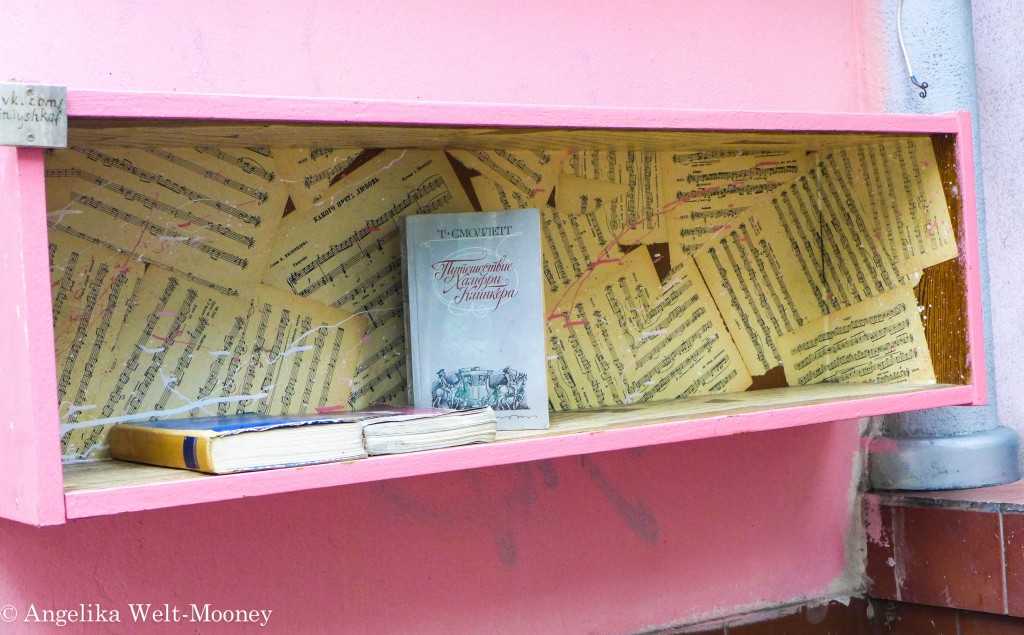
Musical book swap….
… in Kaliningrad
Kommentare deaktiviert für Musical book swap….
Filed under Bücher, Sprache & Fotografie
Ein Buch, das traurig macht
Ich mag Bücher, die eine Handlung einrahmen. Das hat Julia Franck in Die Mittagsfrau meisterhaft getan. Peters Mutter ist für mich die Hauptperson und meine Lieblingsfigur des Romans. Ihr Name wird nicht sofort verraten – aus gutem Grund, wie sich später herausstellt. Warum das Buch traurig ist? Weil selbst die Liebe nicht hilft. Ich habe es sehr gern gelesen, bin in Gedanken in Berlin an den bekannten Orten herumspaziert und habe gehofft …. Mehr kann ich nicht schreiben, ohne zuviel zu verraten, finde ich. Vielleicht sollte ich noch erwähnen, dass die beiden Weltkriege (auch) in diesem Buch vorkommen und ihre verheerenden Spuren bei den Menschen hinterlassen. Und Familien für immer verändern.
Und dass Anthea Bell den Roman ins Englische übersetzt hat. Titel: The Blindness of the Heart.
Kommentare deaktiviert für Ein Buch, das traurig macht
Filed under Bücher, Gelesen, Übersetzen
Neighbours (in Mumbai)
I don’t read a lot of non-fiction, but when I do, I like the book to tell me a good story. When I heard about Behind the Beautiful Forevers, the title made me curious and the fact that it was set in India even more so. Mumbai – vast, with many hidden corners – that is the setting – or rather, Annawadi, a neighbourhood where very poor people live in the vicinity of bustling Mumbai airport. The author Katherine Boo spent three years with the people we get to know in the book and witnessed their joy and their pain – well, it’s mostly pain with a glimpse of hope here and there. Corruption is one big theme and while I was reading the book, I almost despaired of all the injustice, the tedious criminal law procedures and the unfair medical treatment of the very poor. But above all, there was a sense of the very familiar – the squabbles of neighbours, the suspicious looks at somebody who is different, the girl struggling for a better life through education. The kids dream the universal dream of a better life. May at least some of them find it!
Two (Crime) Stories

I listened to John Lanchester when he read from his book Capital and knew I had to read it. It is about London after all – or rather about a street in London. It tells the tale of several families and their sorrows and joys in 2008. Their lives are disrupted by postcards, followed by nastier messages.
The book is also about suspected and real criminal activity, fraudulent and destructive behaviour, love in various forms and great despair. The „hurly-burly of family life“, as the author puts it, is presented to the reader without judgement. The double entendre of the title stayed with me throughout the story – and on a recent visit to London, I was wondering whether it would always be the place of choice for those who have made this city truly great – its people from all over the world and their creative approach to life.
A friend recommended the other story to me. Luckily, one of my favourite London bookshops had this little gem in stock. Dag Solstad’s Professor Andersen’s Night is a fascinating study on solitude, inner monologues, their sometimes rather destructive and misleading nature and on friendships and how they evolve over time. I think it’s a novella. Would you agree?
Gripping
Just a quick note to say: Ratlines by the Northern Irish writer Stuart Neville is a GOOD read and hadn’t been on my book wish list for nothing. After reading a review in the Saturday edition of the Financial Times on 25 January 2013), I was intrigued by this story that travels between Germany’s, France’s and Ireland’s past and the present. But then I forgot about it for a while, until it caught my eyes on my way back to Berlin at Dublin airport. It’s not your ordinary crime thriller, since it uses quite a lot of historical facts and blends them with the fictional (and sometimes not so fictional characters). The main character Lieutenant Albert Ryan has a tough job to do and some difficult decisions to make, testing his integrity and makes him wonder what loyalty means. There are lots of twists in the story and yes, there’s love, too. Or something like it. I know now what the title means. Do you want to find out, too?
Philosophical in 2013
I was given a question for Christmas – and quite a big one it was. No less than Who Are We? was on the agenda. This book by the journalist Gary Younge takes the reader’s thoughts into new directions. Every time I thought „Yes, that’s what I’m already doing. Ok, that’s something I could do better“, there was still another thought around the corner that I hadn’t even contemplated. All wrapped into stories about different people’s identities, why they feel comfortable (or too comfortable) in their own skin or why they don’t. Never really having to justify why I want to cross a particular border is a great privilege. I knew that before I’d read the book. But now I understand even better what it means not to be in that position. Plus: It’s great about Ireland ….
I pass the question on – and recommend the book to anybody who might want to discuss this big question with me and others.
A Reading in London
In my view, there is no better word than visceral to describe Hassan Blasim’s collection of short stories The Madman of Freedom Square. They touched me and they moved me deeply. The stories tell us about the futile nature of war, about displaced people and people who stay at home. Home is in war-torn Iraq, where life is often perilous and marked by the loves, the joys and fears of everyday life. Death comes unexpectedly at home in The Market of Stories, where reading about a shoe has the same effect on me as a film scene with boots in ‚All Quiet on the Western Front‘ – and is expected to turn up at every turn in the story The Truck to Berlin. I was lucky to be able to listen to Hassan Blasim and his English translator Jonathan Wright at an English PEN event, where they introduced the writer’s latest book The Iraqi Christ. They talked about the humour of the stories – a humour that doesn’t mask the horror. Humankind in all its rich facettes – I’m looking forward to reading more by Hassan Blasim.
Kommentare deaktiviert für A Reading in London
Filed under Bücher, Gelesen, Lesung, Übersetzen